From Homespun to Mill Cloth: A Changing Rural Wardrobe
Homespun to mill cloth reshaped rural wardrobes unevenly. Learn how local fibre, trade routes and household resources influenced what people could make or buy.
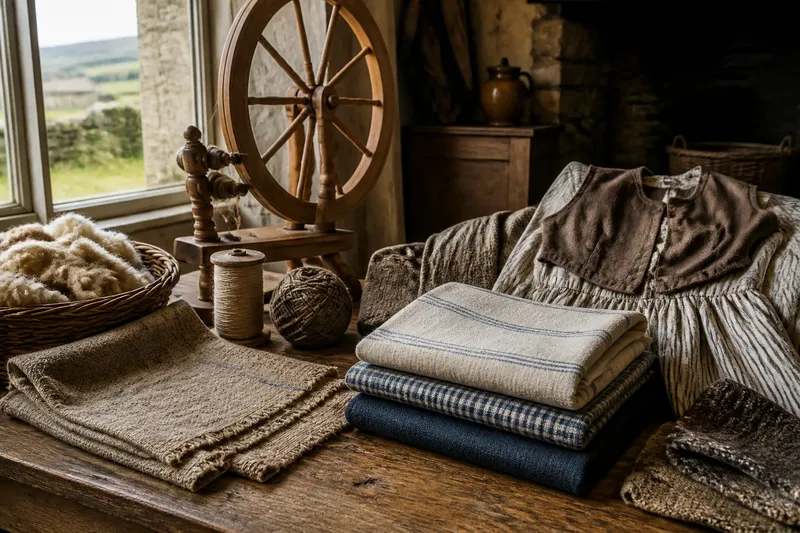
Homespun to mill cloth did not arrive at every rural doorstep in the same way. In an upland household with wool, a spinning wheel and a local weaver, cloth might still begin close to home; near a market, a length of bought fabric could save labour or offer a different choice. The shift was uneven, and the evidence needs a place and period attached to it.
What counts as homespun?
Homespun generally means yarn spun within a household, though weaving might happen at home or be done by a local craft worker. The fibre could come from livestock or crops, or be obtained through exchange. A garment made from homespun yarn, then, was not necessarily produced entirely under one roof.
Making cloth involved several distinct tasks: preparing fibre, spinning yarn, weaving fabric, and cutting and sewing garments. A household might handle some stages and pay or barter for others. This distinction helps explain why the arrival of purchased cloth did not instantly remove domestic textile work.
When did mill cloth reach rural communities?
There was no single countryside-wide turning point. In Britain, the spread of mechanised textile production and the growth of commercial cloth markets unfolded over the long eighteenth and nineteenth centuries, but the timing and effects varied by region. Industrial production expanded in places such as Lancashire and the West Riding of Yorkshire; rural households elsewhere encountered its products through merchants, market towns, fairs, travelling sellers and other trade links.
That broad historical frame does not establish when a particular village first had regular access, or what its residents could afford. A mill’s existence in a region is not proof that its cloth was readily available in a more distant settlement. For a local account, specify the district and period, then look for evidence such as shop records, advertisements, household inventories, account books or surviving garments. Each source has limits: an advertisement shows an offer, for instance, not necessarily a purchase by every household.
What shaped the choice to make or buy?
Four practical conditions help explain the mix: access to fibre and tools, local skills, trade connections and household resources. Seasonal work mattered too, since time spent preparing and spinning fibre competed with farming and other tasks. No single condition settles the question; together, they describe the options a household could realistically use.
- Local fibre: If wool or flax was available and usable, household spinning was possible; if not, consider purchased or exchanged fibre instead.
- Tools and skill: If spinning equipment and skilled hands are documented, household yarn-making becomes plausible; if weaving skill is absent, look for a local weaver or bought fabric.
- Trade access: If market visits, peddlers or shops are documented, purchased cloth could circulate; if routes were difficult, investigate occasional exchange rather than assuming complete isolation.
- Money and timing: If records show cash income at particular times, consider purchases made then; if cash was limited, consider making, mending, reuse or barter.
- Household labour: If other seasonal tasks took priority, buying some cloth may have reduced textile work; if labour and skill were available, home production could remain useful.
- Cloth in garments: If surviving clothing combines materials or construction methods, consider a mixed wardrobe; if evidence covers only one garment, avoid treating it as representative of the whole household.
The list is a way to frame questions, not a substitute for local evidence. A trade route shows that cloth might arrive; it does not establish who bought it. A spinning wheel shows capacity, not how often it was used.
How did bought cloth alter household work?
Purchased yarn or fabric could shift some labour away from fibre preparation, spinning or weaving, but not necessarily from sewing and garment care. A household might buy cloth and cut it at home, or purchase yarn and arrange for a local weaver to make it into fabric. Homespun could remain in use for other garments.
Think of a pantry stocked partly from a kitchen garden and partly from a shop: a new source adds options without making the old one vanish. In clothing, the balance depended on the task, the material and what the household could obtain.
How can you test an explanation against local evidence?
Say you are writing about an invented village in the Pennines during the early nineteenth century. Your starting notes say that a household keeps sheep, has a spinning wheel, and trades at a market town; you have no surviving household account book. First, record what those notes support: wool and equipment make home spinning plausible, while the market connection makes purchases possible. Next, mark what remains unknown: the notes do not show whether this family bought mill cloth, how often it visited the market or what it could afford. Then compare any available local records, such as a shop advertisement or an inventory, without treating either as proof of universal access. Your resulting account can say that homespun and purchased cloth were both possible routes, while leaving the household’s actual purchases unresolved.
Which clues answer common questions about rural cloth?
Does homespun mean every stage happened at home?
No. Yarn might be spun in the household and woven by a local specialist. Describe each stage separately when the evidence allows.
Did mill cloth replace homespun at once?
No single transition date applies to every rural community. Trade, affordability, available skills and household needs shaped how quickly purchased cloth joined or displaced home production.
Does a nearby market prove a family bought fabric?
No. A market indicates a possible route to goods, not a particular household’s spending. Household accounts, inventories or garment evidence may help, but each supports different kinds of claims.
Could a rural wardrobe contain both kinds of cloth?
Yes. A household could use homespun for one purpose and buy yarn or fabric for another. Mixed sources are a more cautious possibility than assuming a complete switch based on one clue.
How should you describe the change?
Name the place, period and textile stage involved. “Purchased cloth circulated through local markets while some households continued spinning” is more precise than saying that rural people stopped making cloth. Where evidence is thin, distinguish what was possible from what was common, and what was sold from what a household could afford.
Homespun to mill cloth is best understood as a changing set of routes, not a clean replacement. For any particular community, the useful questions are who could obtain fibre, who had the necessary skills, how goods reached the area and what household resources permitted. Keeping those questions tied to local evidence makes room for both the new cloth and the work that continued around it.